
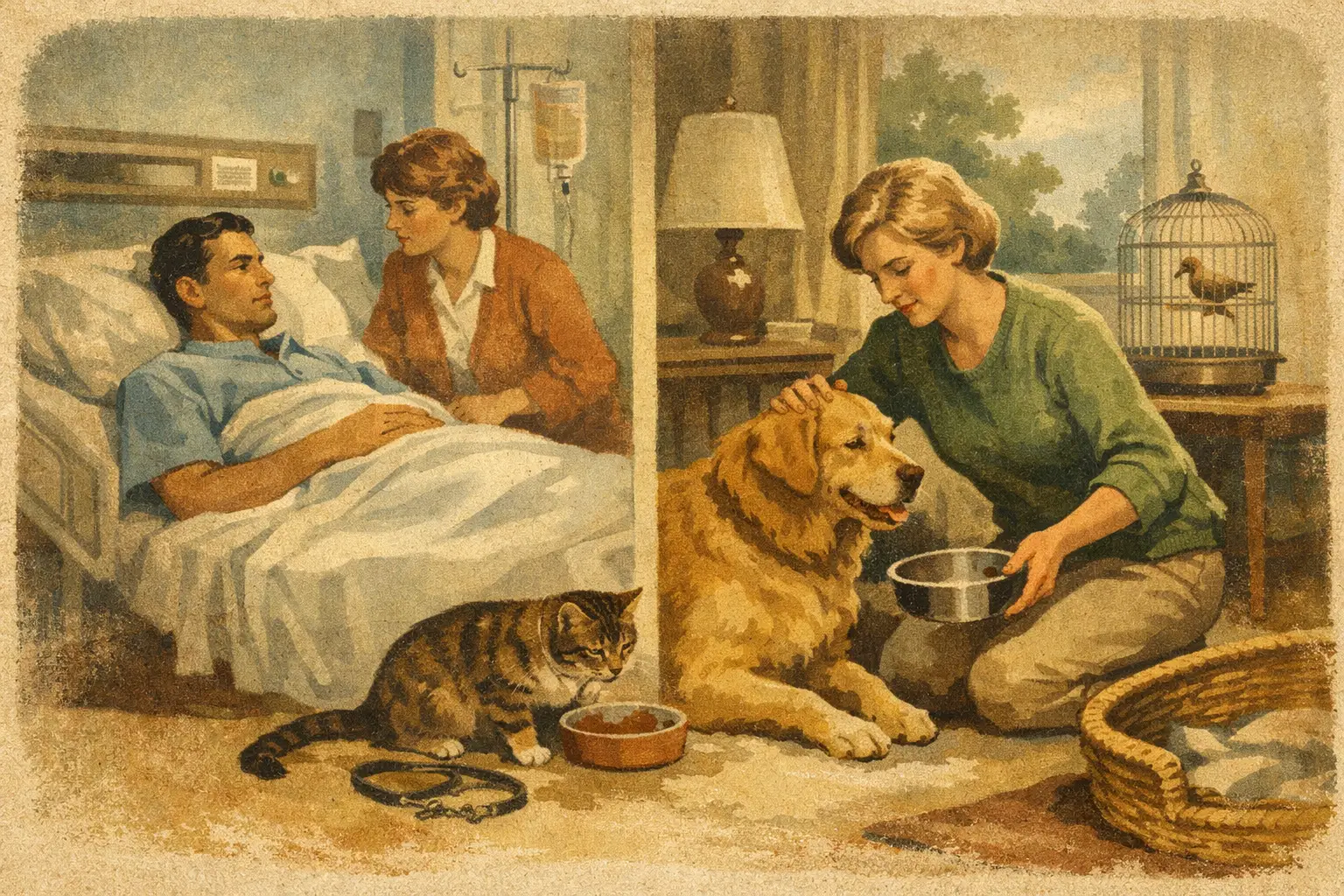
A hospital stay can happen with no warning. One minute you are heading to the ER, preparing for surgery, or helping a parent through a medical crisis. The next, you are trying to answer a painful practical question: who takes care of pets when owner is hospitalized?
For many people, the first assumption is that a friend, neighbor, or family member will step in. Sometimes that works. Sometimes it does not. The real answer depends on how long the hospital stay may last, whether the pet needs medication, how quickly care has to start, and whether anyone close by can reliably follow the animal’s routine.
What matters most is simple: the pet needs safe, immediate, consistent care, and the owner needs to know that care will continue even if the medical situation changes.
Who takes care of pets when owner is hospitalized?
In practice, pet care during hospitalization usually falls to one of four groups: family or friends, a trusted neighbor, a professional pet-care provider, or in some cases a boarding facility. Hospitals themselves usually do not provide direct pet care. However, case managers, social workers, discharge planners, and senior-service professionals may help patients identify options quickly.
That distinction matters. A hospital may help coordinate support, but it rarely assumes responsibility for feeding, walking, medicating, or monitoring an animal. If a patient lives alone, has no nearby relatives, or owns a pet with medical or behavioral needs, a professional in-home care service is often the safest fit.
Keeping the pet at home is often the least disruptive option. Dogs, cats, birds, reptiles, fish, and other companion animals tend to do better when they can stay in familiar surroundings with their normal food, bedding, smells, and routine. Boarding can be appropriate in some situations, but it is not always ideal for elderly pets, anxious pets, multi-pet homes, or animals that require medication and close observation.
Why casual help is not always enough
In a true medical emergency, people naturally start calling whoever might be available. That urgency can push owners and families toward the fastest answer instead of the most dependable one.
A well-meaning neighbor may be able to fill a food bowl once or twice, but that is different from managing insulin, seizure medication, recovery restrictions, or a dog that refuses to go out for someone unfamiliar. Friends also have jobs, children, travel plans, and their own health demands. If the hospital stay stretches from one night to five, or from five days to two weeks, casual help can fall apart quickly.
There is also the issue of accountability. If keys are misplaced, a pet gets loose, medication is missed, or the home shows signs of a water leak or power problem, who notices? Who documents care? Who updates the family or case manager? In healthcare-triggered situations, those details are not small.
Professional emergency pet care exists because medically related absences create a different kind of pressure. They require speed, calm communication, and a plan that can adapt as test results, discharge dates, and treatment schedules shift.
What good emergency pet care should include
If you are trying to decide who should care for a pet during hospitalization, the right question is not just, “Can someone stop by?” It is, “Can someone provide complete, reliable care for as long as this medical event lasts?”
That care should include the basics - food, water, potty breaks, litter box care, exercise, and companionship - but it should not stop there. In many homes, pets also need oral medications, injections, mobility support, routine monitoring, and behavior-aware handling.
For vulnerable owners, the best services also account for the household itself. That can mean bringing in mail, checking for hazards, confirming heat or air conditioning is working, and reporting concerns that matter while the owner is away. A hospitalized person should not have to wonder whether the dog was actually walked or whether the cat’s appetite changed yesterday.
In healthcare-adjacent cases, clear communication is part of care. Updates to the owner, family contact, social worker, or discharge team can make a real difference, especially when discharge plans depend on whether the pet is safe at home.
When in-home care is better than boarding
Boarding is not wrong by default. For some pets, especially healthy, social dogs with current vaccines and no medical complications, it can be a workable short-term option. But there are trade-offs.
Transport has to be arranged, often on short notice. The pet has to tolerate a new environment, new handlers, new sounds, and separation from home. Cats often find this especially stressful. Senior pets and medically fragile pets may struggle with the disruption. Exotic species, fish, backyard animals, and livestock may not have any realistic boarding option at all.
In-home care is often more appropriate when the pet is elderly, anxious, medicated, bonded to a specific routine, or part of a multi-animal household. It is also the better answer when the owner’s absence is tied to a serious health event and there is no clear end date yet. Home-based care offers continuity when the human situation is uncertain.
That is why specialized services like Yavapai Pet Care are built around the question so many families face in crisis: who takes care of pets when owner is hospitalized if there is no one else available right now?
What hospitals, social workers, and case managers can actually do
Many families assume the hospital will “handle something” for the pet. Usually, the hospital’s role is supportive, not hands-on.
A social worker or case manager may help contact emergency numbers, look for community resources, or connect a patient with a local provider. They may also document barriers to discharge if the patient cannot safely return home because no pet care is in place. That can be especially relevant for seniors, people recovering from surgery, and patients entering rehab or hospice-related care.
Still, hospitals are focused on human medical treatment. They need dependable outside partners when a patient says, “My dog is alone,” or “My cat needs medication tonight.” That is why community-based pet care providers with emergency response capability can play such an important role. They fill the gap between medical care and home stability.
How to prepare before a hospitalization happens
The hardest time to create a pet-care plan is during an ambulance ride. If you live alone, manage a chronic illness, or know a procedure is coming up, it helps to prepare in advance.
Start with a written pet-care file. Include feeding instructions, medication details, veterinarian contact information, behavior notes, emergency contacts, alarm instructions, and where supplies are stored. Keep it somewhere visible. If possible, let at least one trusted person know where house keys or access instructions can be found.
It also helps to choose a primary and backup caregiver ahead of time. If your first option cannot respond, you do not want your pet waiting for a second round of phone calls. For patients with higher risk of hospitalization, establishing care with a professional service before a crisis can remove a huge burden later.
Preparation is not pessimistic. It is protective. It respects the fact that pets still need routine and safety when life changes fast.
Signs you need a professional, not informal help
If the pet needs medication, the owner may be hospitalized longer than expected, no family lives nearby, or the home has multiple animals or specialty species, professional care is usually the safer route. The same is true when the owner is a senior living alone, entering rehab, managing repeated hospitalizations, or facing a hospice transition.
Another sign is uncertainty. If nobody can say with confidence who will show up tomorrow morning, who has permission to enter the home, or who can continue care for several days in a row, the plan is too fragile.
Professional support brings structure to a chaotic moment. It means there is a defined caregiver, a clear schedule, documentation, and someone whose job is to keep the pet stable while the owner focuses on treatment and recovery.
A better question to ask in a crisis
Instead of asking only who can help, ask who can keep helping if the situation changes. Hospital stays run long. Discharges get delayed. Rehab gets added. Medications change. Family members leave town. The best pet-care plan is the one that still works on day five, not just the one that sounded possible on day one.
When people are sick, scared, or recovering, peace of mind matters. Knowing a pet is fed, safe, medicated if needed, and resting in familiar surroundings can remove one of the biggest emotional burdens of a hospital stay.
If you are facing that question now, choose the option built for reliability, not just availability. Your pet does not need a favor. Your pet needs care you can count on when life happens.